
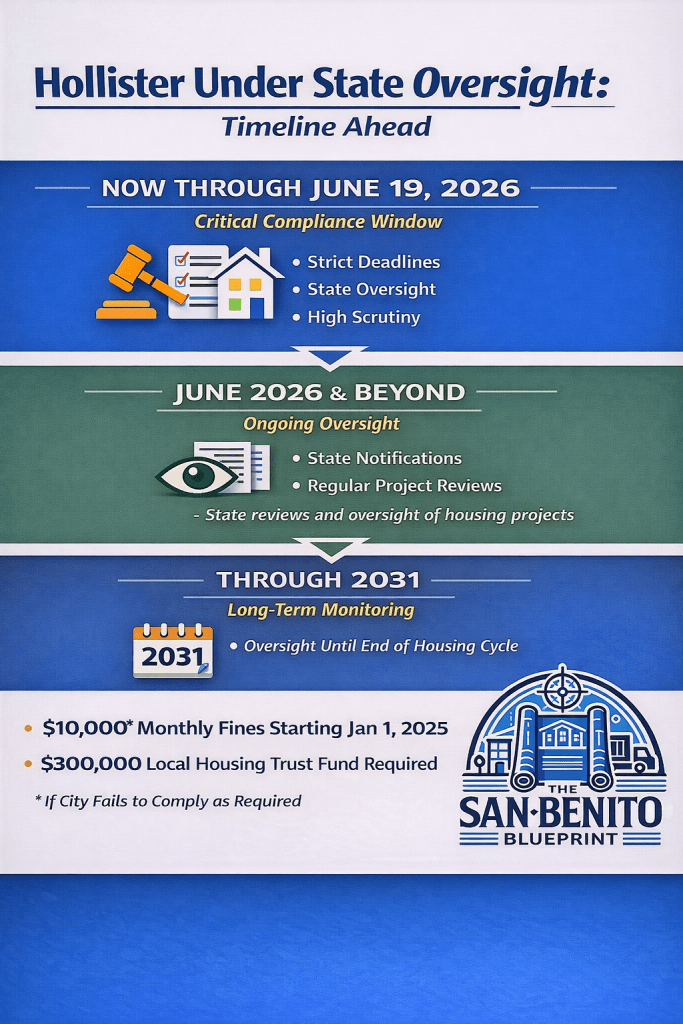
The State of California has officially stepped in.
In a newly filed court action, the State, through the Attorney General and the Department of Housing and Community Development, has reached a proposed settlement with the City of Hollister over its failure to adopt a compliant Housing Element for the 2023 to 2031 planning cycle. This is not just another warning letter. It is a legally binding agreement that lays out exactly what the City must do and when it must do it.
Background
Hollister missed its December 15, 2023 deadline to adopt a compliant Housing Element and, as of today, remains out of compliance with state law That failure triggered escalating state involvement, including a formal notice of violation and now this court enforced agreement. Rather than fight the case in court, both sides agreed to a stipulated judgment. In simple terms, the City is agreeing to fix the issue under strict oversight and timelines.
The Immediate Timeline
The agreement lays out a firm schedule:
- April 20, 2026. City Council must adopt a compliant Housing Element
- May 4, 2026. Required rezoning must be fully approved
- June 19, 2026. HCD certification expected
These are not flexible targets. They are court backed deadlines.And importantly, Hollister is not considered compliant until the rezoning is completed and HCD signs off.
The Settlement
The state is watching project decisions
The agreement adds a new layer of oversight on housing projects. For the remainder of the housing cycle (2031), the City must notify HCD when it receives housing applications and provide detailed findings if it denies certain housing projects. This is especially true for affordable housing and similar developments. In practice, this makes it significantly harder for the City to deny projects without strong legal justification.
Limits on denying housing
Because Hollister is out of compliance, it temporarily loses some of its ability to block housing projects. The agreement reinforces that the City cannot deny or condition certain housing developments in ways that make them infeasible, particularly those that include lower income units. This aligns with broader state housing laws that reduce local control when cities fall out of compliance.
A new housing trust fund
The City is also required to create a local housing trust fund and deposit $300,000 dollars into it. The fund must support housing for lower income residents and other priority housing types. If the funds are not used within five years, they will be transferred to a state housing fund.
The financial pressure
There is also a financial component behind all of this. The agreement establishes penalties of 10,000 dollars per month starting January 1, 2025. Those penalties are currently paused, but they can be enforced if the City fails to meet the terms of the agreement In other words, the fines are real. They are just waiting in the background.
What this means for Hollister
This agreement changes the landscape in a few key ways. First, the timeline is now fixed. The City no longer has the ability to delay without consequences. Second, housing approvals will face greater scrutiny from the state, especially if projects are denied. Third, rezoning will move forward whether or not there is local consensus, because it is now a legal obligation. And finally, this is a clear example of how the state is enforcing housing law in real time.
Hollister is now operating under a court backed roadmap to get into compliance. The next few months will be critical.
Stay tuned for more.
Read the full proposed settlement here

 The San Benito Blueprint
Leave a comment