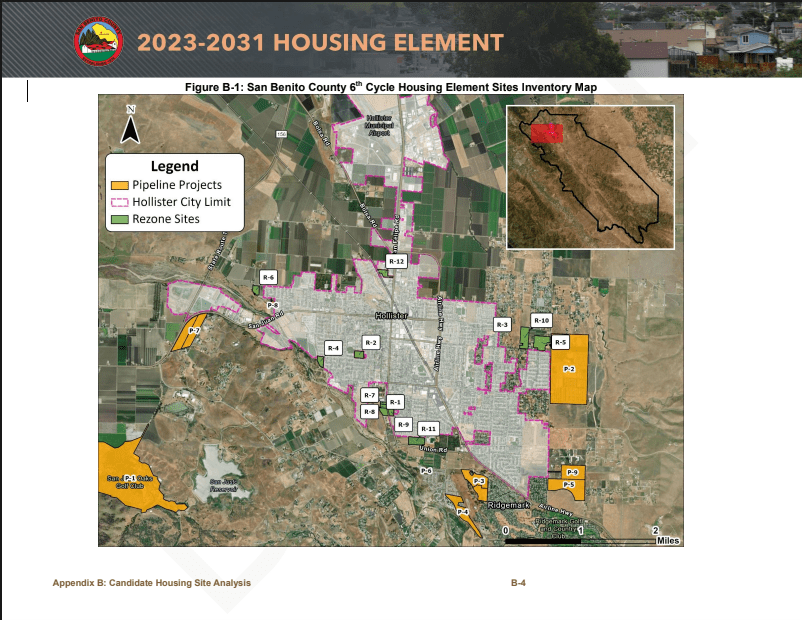
[Image courtesy of the San Benito County 6th Cycle Draft Housing Element 11.04.24]
This is part 1 of a multi-part series that dives into state housing policy and its local impact on San Benito County. Heads up, there is a lot of information in this post and its links, take breaks, grab a coffee, tea, beer or wine and get after it!
- The Housing Element
- Regional Housing Needs Determination and Allocation
- Status of SBCOG Jurisdictions Housing Elements Today
- Appendix: Access Your Local Jurisdictions Most Recent Housing Element Draft and More Resources
The Housing Element
Before we dive into housing elements it’s important to understand a few definitions:
A Housing Element is one of 7 required “elements” (think chapters) that the state of California requires in a city’s general plan.
A General Plan is a blueprint for how a city or jurisdiction will grow or operate in the future. General plans are mandated in the state of California to include the following elements: land-use, circulation, housing, conservation, open space, noise, and safety. There are other elements that may be required or can be included in addition to the mandated elements listed above.
The housing element is essentially a blueprint for how a jurisdiction will meet its housing needs as determined by California Department of Housing and Community Development (HCD for short). It is the result of a multi-step process that allocates and distributes a calculated amount of housing units divided by income levels.
“An effective housing element provides the necessary conditions for preserving and producing an adequate supply of housing affordable to people at a variety of income levels. Among other things, the housing element provides an inventory of land adequately zoned or planned to be zoned for housing, certainty in permit processing procedures, and a commitment to assist in housing development through regulatory concessions and incentives’ – California HCD, “Building Blocks: Before You Start”
Housing elements are required to be updated by the state at either a 5 or 8 year increments. These increments are referred to as “cycles.” Currently we (San Benito Council of Governments [COG for short] which includes Hollister, San Juan Bautista, and Unincorporated San Benito County) are in the 6th cycle. The 6th cycle began in 2023 and lasts until 2031.
A housing element is to be drafted by the jurisdiction and certified by HCD in order to be considered “compliant.” The jurisdiction must then adopt the element into law. Non-compliant housing elements risk loss of state funding, potential fines, litigation, and trigger a process known as Builder’s Remedy.
Housing elements are not new, being mandated in jurisdictions across the state since 1969. There have since been several revisions and enforcement updates given since 2017 with the most notable being SB167 in 2017 and SB330 declaring a Housing Crisis in 2019. Many revisions and enforcement updates have been made most recently AB1893. Long story short, the state is attempting to address the housing shortage by asking all jurisdictions to plan and approve for their fair share.
Regional Housing Needs Determination and Allocation
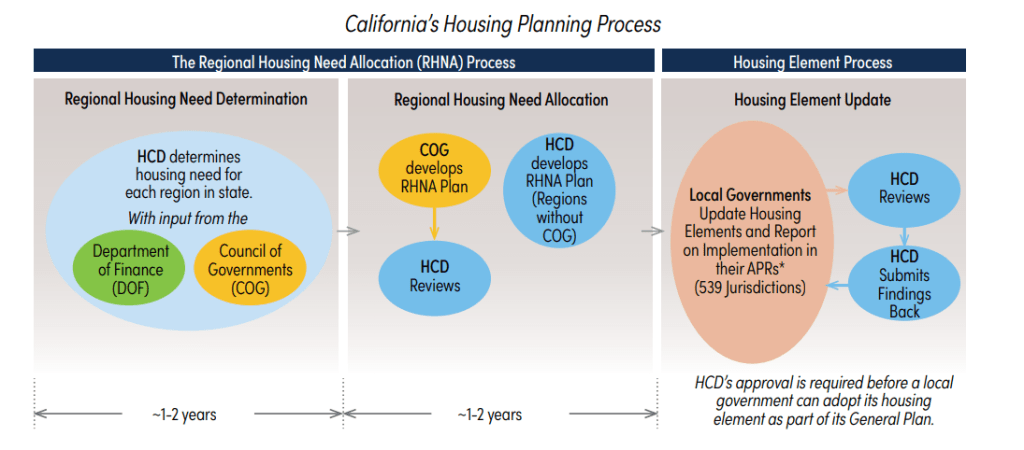
You may have seen or heard discussions regarding “state mandate housing” but what does that mean?
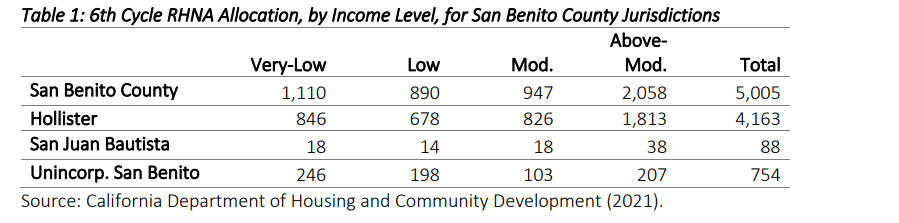
The phrase state mandated housing usually refers to the Regional Housing Needs Allocation or RHNA (pronounced ree na). These numbers are determined by a process called Regional Housing Needs Determination. The state, essentially utilizes a complicated formula that factors in projected population by the end of the cycle, occupied households, vacancy rates, and overcrowding. From there, the state divides them into 4 sub categories: Very Low Income (also includes extremely low income), Low Income, Moderate Income, and Above Moderate (or market rate) Income.
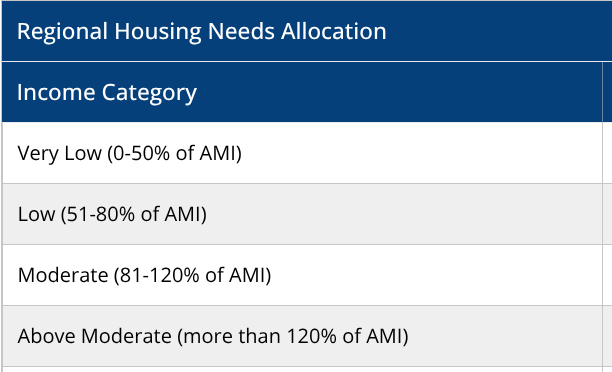
HCD’s determination for SBCOG in the 6th cycle which began in 2023 can be accessed here.
HCD then gives that allotment to the regional council of governments to divy and assign them within their jurisdictions. The COG must do this before housing elements can be worked on. HCD and local jurisdictions can then appeal the allocations within 45 days with supporting documentation.
SBCOG’s approved RHNA 6th Cycle Plan can be viewed here. This plan was approved at the November 17th. 2022 SBCOG Board of Directors meeting.
Status of SBCOG Jurisdictions Housing Elements Today
So where do we stand?
Well, it’s not looking great.
All 3 jurisdictions in San Benito County are currently listed as non-compliant by the state. The state also recently sent a letter to San Benito County on their housing element determining its most recent update was non-compliant, this was on 1/13/25 (see appendix). Meanwhile the City of Hollister’s is due for a response by the 31st of January.
San Juan Bautista has not sent in a revised draft of their housing element which was determined by HCD to be non-compliant back in August.
According to an HCD Media Relations response to our inquiry, all jurisdictions in San Benito County are currently eligible to have builders remedy projects submitted and may currently lose out on potential funding opportunities from the state.
Builders remedy is a provision that limits a local jurisdictions ability to reject housing developments provided they meet certain criteria. Housing projects submitted under builders remedy do not necessarily have to comply with zoning regulations and density limits established by local governments.
Builders Remedy law was recently updated as of January 1st 2025 to include new regulations. A high level summary is that a developer can qualify for builders remedy if one of the following conditions are met:
- 7% or more of all units are reserved for extremely low income
- 10% or more of all units are reserved for very low income
- 13% or more of all units are reserved for low income
- 100% of all units are for moderate income
Builder’s remedy projects are permitted to build up to 3x the max zoning for a specific site, this is without density bonuses (we’ll go into that in a future article). Newer regulations require affordable units to have comparable bedroom and bathroom sizes to their market-rate counterparts. More on Builder’s Remedy soon. Stay tuned.
Appendix: Access Your Local Jurisdictions Most Recent Housing Element Draft and More Resources
Local Housing Elements:
- San Juan Bautista [Found non-compliant 8/2/24, revisions not yet submitted]
- City of Hollister [State to release review on January 31st]
- San Benito County [Found non-compliant 1/13/25 letter below]
San Benito County Recent Review Letter:
The San Benito Blueprints Media Inquiry to HCD:
Links Links Links:
California Department of Housing and Community Development Open Data Tools
California Department of Housing and Community Developments Technical Assistance Page
California Department of Housing and Community Developments Accountability and Enforcement Page
Coming Soon “The Housing Element Part 2: Builder’s Remedy and The Cost of Non-Compliance”


 The San Benito Blueprint
Leave a reply to The Housing Element Part 2: Builder’s Remedy and The Cost of Non-Compliance – The San Benito Blueprint Cancel reply